What Happens If You Stop Paying Credit Card Debt and How Can You Manage It?
Credit card debt can become difficult to handle when unexpected expenses, job loss, medical bills, or a sudden drop in income affect your monthly budget. When paying your bills becomes a struggle, you might start wondering what happens if you stop paying your credit card.
Missing a payment may seem like a temporary problem, but leaving your credit card balance unpaid for several months can create bigger financial challenges. Your issuer may charge late fees, increase your interest rate, report missed payments to credit bureaus, and eventually send your account to collections. In some cases, you could even face a lawsuit.
However, these consequences usually develop over time. Knowing what to expect at each stage can help you understand your rights, evaluate repayment options, and avoid decisions that make your financial situation harder to manage.
Let's look at what happens when you stop making credit card payments, how long the consequences last, and what you can do if your debt becomes difficult to repay.
What Happens If You Stop Paying Your Credit Card?
When you miss a required credit card payment, your account becomes delinquent. The longer it remains unpaid, the more serious the consequences can become.
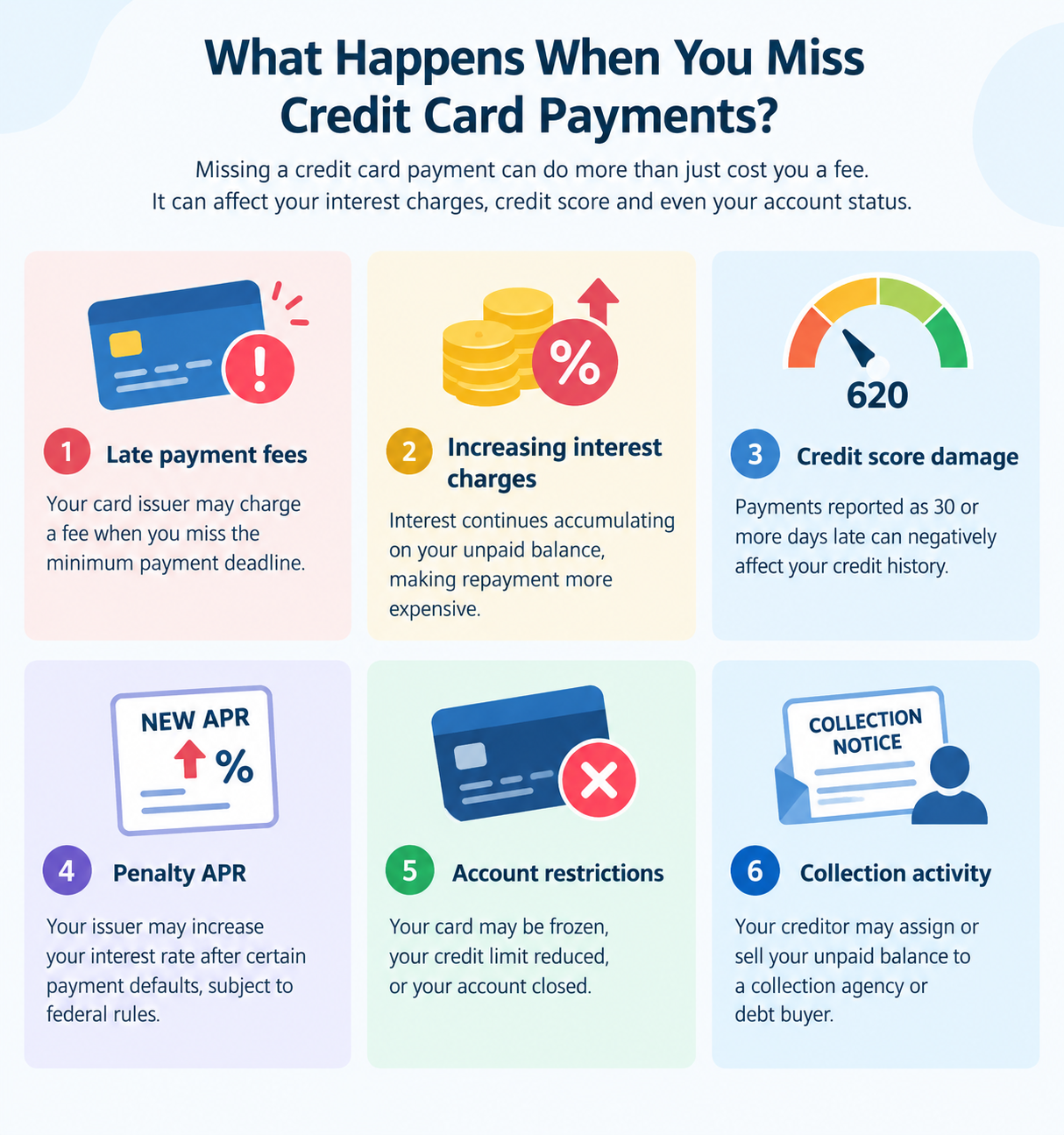
Depending on your card agreement and circumstances, you may experience:
- Late payment fees: Your card issuer may charge a fee when you miss the minimum payment deadline.
- Increasing interest charges: Interest continues accumulating on your unpaid balance, making repayment more expensive.
- Credit score damage: Payments reported as 30 or more days late can negatively affect your credit history.
- Penalty APR: Your issuer may increase your interest rate after certain payment defaults, subject to federal rules.
- Account restrictions: Your card may be frozen, your credit limit reduced, or your account closed.
- Collection activity: Your creditor may assign or sell your unpaid balance to a collection agency or debt buyer.
- Possible legal action: Your creditor or a debt buyer may sue to recover the outstanding amount.
Not every credit card company follows the exact same collection timeline. However, understanding the common stages can help you prepare for the possible financial impact.
What Happens When You Miss Credit Card Payments? A Timeline
The consequences of unpaid credit card debt generally become more serious as your account moves further past due. Here's a closer look at what may happen at each stage.
 1. 1–29 Days Late: Late Fees and Additional Interest
Missing your payment deadline can lead to a late fee, even if you're only a few days behind. Your existing balance may also continue accumulating interest based on your card's APR.
At this point, your issuer may send payment reminders through email, text messages, or phone calls.
The good news is that credit card issuers generally report late payments to the major credit bureaus only after an account becomes at least 30 days past due. Paying the overdue amount before that point may help you avoid a 30-day late-payment entry on your credit report.
What you can do: Make the minimum payment as soon as possible if you can afford it. If you missed the deadline accidentally, contact your issuer and ask whether it can waive the late fee.
2. 30 Days Late: Your Credit Score May Drop
Once your payment becomes 30 days overdue, your credit card issuer may report the delinquency to Experian, Equifax, and TransUnion.
This can affect your credit score because payment history is the largest factor in a FICO Score, accounting for 35% of its calculation.
A late payment may also make it harder to qualify for new credit cards, personal loans, or other financing. The actual score impact depends on your existing credit history and overall credit profile.
What you can do: Contact your issuer immediately and ask about bringing the account current. If you cannot afford the full payment, explain your financial circumstances and ask whether a hardship arrangement is available.
3. 60 Days Late: Penalty APR May Increase Your Debt
When your account reaches 60 days past due, your credit card issuer may have additional options under federal credit card regulations.
Under Regulation Z, an issuer may generally apply a penalty APR to an existing balance if it has not received the required minimum payment within 60 days after the due date, subject to applicable conditions.
For example, if your regular APR is 20% and the penalty APR is 29%, the interest charged on your balance could increase considerably.
Your issuer may also restrict new purchases, suspend your account, or take steps to reduce its potential losses.
What you can do: Ask your issuer whether it can offer a lower interest rate, waive certain fees, or arrange a manageable repayment schedule. Review the terms carefully before agreeing to a new payment arrangement.
4. 90 Days Late: Your Account May Be Restricted or Closed
After three missed billing cycles, your account may be considered seriously delinquent.
Your credit card company may close your account or suspend your access to available credit. Additional late-payment information may also be reported to the credit bureaus, further affecting your credit history.
At this stage, the outstanding balance may have increased because of accumulated interest and fees. Catching up can become more difficult, especially if you are already struggling with other monthly expenses.
What you can do: Review your income, essential expenses, and total debt. Contact your creditor to discuss a hardship program or structured repayment option. A nonprofit credit counselor may also help you assess your financial position.
5. Around 120–180 Days Late: Charge-Off and Collections
When a credit card account remains unpaid for several months, the consequences can become more serious.
Under federal banking rules, credit card issuers generally must charge off delinquent credit card debt at 180 days past due. A charge-off means the lender records the account as a loss for accounting purposes.
However, a charge-off does not mean your debt has been forgiven or canceled. You remain responsible for the unpaid amount unless it is legally discharged or otherwise resolved.
After a charge-off, your creditor may:
- Continue attempting to collect the outstanding balance.
- Assign the account to a third-party collection agency.
- Sell the debt to a debt buyer.
- Consider filing a lawsuit to recover the amount owed.
The original account and any collection account may appear on your credit report, subject to applicable reporting rules.
What you can do: Verify the debt and the amount being claimed. If you receive a collection notice, review your rights and any applicable debt validation deadlines. Consider speaking with a qualified financial counselor or attorney before making an agreement.
What Happens to Your Credit Score If You Stop Paying Your Credit Card?
Your payment history has a major influence on your credit score. When you stop making payments, your credit profile can suffer in several ways.
Here are the main effects:
1. Late Payment Records
Once your account becomes 30 days past due, your issuer may report the missed payment to the credit bureaus. Additional missed payments can lead to more serious delinquency records.
2. Higher Credit Utilization
If your card issuer reduces your credit limit or closes your account while you still have an outstanding balance, your overall credit utilization may increase. A higher utilization ratio can put additional pressure on your credit score.
3. Charge-Off Records
A charged-off credit card account is a serious negative entry. It can remain on your credit report for up to seven years from the date of the delinquency that led to the charge-off.
4. Collection Accounts
If your original creditor sells or transfers the debt to a collection agency, a collection account may also appear on your credit report. The reporting details depend on how the debt is handled.
Can your credit score recover?
Yes. Missed payments can remain on your credit report for years, but their influence on your score can decrease over time. Bringing accounts current, paying bills on time, reducing credit card balances, and checking your credit reports for errors can help rebuild your credit history.
Can a Credit Card Company Sue You for Unpaid Credit Card Debt?
Yes. A credit card issuer or debt buyer can file a civil lawsuit to recover unpaid credit card debt. However, a lawsuit is not an automatic consequence of missing payments.
If the creditor wins the case, the court may issue a judgment allowing certain collection measures under applicable state law. These may include:
- Wage garnishment: A portion of your earnings may be withheld to repay the judgment.
- Bank account levy: Funds in your bank account may be seized, subject to applicable exemptions.
- Property lien: A creditor may be able to place a lien against certain property.
The legal process and available collection methods vary by state. Federal and state laws also protect certain types of income from collection in many circumstances.
What if you receive a lawsuit notice?
Never ignore court papers. Read the documents carefully and respond before the deadline mentioned in the notice. You can ask the creditor to prove that the debt is valid and that it has the legal right to collect it.
You may also consult a consumer debt attorney or legal aid organization to understand your options.
Can You Go to Jail for Unpaid Credit Card Debt?
No. In the United States, failing to repay ordinary credit card debt is generally a civil matter, not a criminal offense. You cannot be jailed simply because you cannot afford your credit card payments.
However, ignoring certain court orders or failing to comply with legal proceedings can create separate legal complications. Always respond to official court notices.
How Long Does Unpaid Credit Card Debt Stay on Your Credit Report?
Most negative credit information, including late payments and charge-offs, can remain on your credit report for up to seven years.
The seven-year reporting period generally begins from the date of the original delinquency that led to the negative account status. A creditor selling your debt to another collection agency does not automatically restart this reporting period.
Here's a quick overview:
Paying or settling a debt does not automatically remove accurate negative information from your credit report. However, if you find incorrect balances, duplicate collection accounts, or inaccurate payment dates, you have the right to dispute those errors with the credit reporting agencies.
What Should You Do If You Cannot Pay Your Credit Card Bills?
If you are struggling with credit card payments, ignoring the problem can make your debt more expensive and difficult to resolve. Consider these options before your account becomes seriously delinquent.
1. Contact Your Credit Card Company
Your first step should be contacting your card issuer. Explain why you're struggling to make payments and how much you can realistically afford.
Some credit card companies offer hardship programs that may include:
- Temporarily reduced interest rates
- Lower monthly payment requirements
- Waived late fees
- Temporary payment arrangements
Ask about the eligibility requirements, program duration, and how the arrangement will be reported to credit bureaus.
2. Consider a Debt Management Plan
A debt management plan (DMP) can help you manage multiple unsecured debts through a structured repayment arrangement.
Nonprofit credit counseling agencies may negotiate with creditors to reduce interest rates or make monthly payments more manageable. You generally make one payment to the counseling agency, which distributes the funds among participating creditors.
This option may work well if you have a regular income and can repay your debt over time.
3. Explore Debt Settlement
Debt settlement involves negotiating with creditors or debt collectors to accept less than the full outstanding balance as a settlement.
Some people consider this option when their financial circumstances make full repayment unrealistic. However, settlement comes with important risks.
For example, some debt settlement programs ask consumers to stop making payments while they save money for a negotiated settlement. During that period, late fees and interest may continue accumulating, credit scores can decline, and creditors may pursue collection activity or lawsuits.
Before enrolling, understand the company's fees, settlement process, potential tax consequences, and the possibility that some creditors may refuse to negotiate.
A debt settlement company also cannot guarantee that every creditor will agree to reduce your balance.
4. Look Into Debt Consolidation
Debt consolidation combines multiple outstanding debts into one new loan or repayment arrangement.
For example, you may qualify for a personal loan with a lower APR than your existing credit cards. You can use the loan proceeds to repay those balances and then make one fixed monthly payment.
Before choosing consolidation, compare:
- Interest rates and APR
- Origination and other fees
- Loan repayment duration
- Total amount payable
- Eligibility requirements
Debt consolidation can simplify repayment, but it does not eliminate what you owe.
5. Speak With a Bankruptcy Attorney
If your debt has become unmanageable and your income cannot support repayment, bankruptcy may be worth discussing with a qualified attorney.
In the United States, individuals generally consider two common options:
- Chapter 7 bankruptcy: May eliminate certain eligible unsecured debts through a legal process, subject to qualification requirements and exemptions.
- Chapter 13 bankruptcy: Allows eligible individuals with regular income to follow a court-approved repayment plan, generally lasting three to five years.
Bankruptcy has serious credit and financial consequences, so professional legal advice is important before making a decision.
Important Things to Know Before Dealing With Old Credit Card Debt
Unpaid credit card debt can create confusion, particularly when an account has been transferred to a collection agency or has remained unpaid for several years.
Keep these points in mind:
Check the statute of limitations: Each state has its own rules governing how long a creditor or debt collector can sue to recover a debt. The applicable period depends on state law and the circumstances of the debt. In some states, making a payment or acknowledging an old debt can restart the limitation period. Seek legal advice before paying or acknowledging potentially time-barred debt.
Understand your debt collection rights: The Fair Debt Collection Practices Act (FDCPA) protects consumers from certain abusive, deceptive, and unfair collection practices by covered debt collectors. You may have the right to request debt validation and dispute information about a debt.
Be careful with settlement agreements: If a creditor or collector agrees to accept less than the full balance, get the agreement in writing before paying. Confirm that the payment will settle the specified debt and clarify whether any remaining balance will be forgiven.
Consider possible tax consequences: If a creditor forgives part of your debt, the canceled amount may be treated as taxable income. Certain exceptions and exclusions may apply, including insolvency and bankruptcy. Consult a qualified tax professional about your circumstances.
Final Thoughts
Stopping credit card payments without understanding the consequences can lead to rising balances, damaged credit, collection activity, and possible legal action. A missed payment can become a much bigger financial problem when it remains unresolved for several months.
The best approach is to understand your financial position early and evaluate realistic repayment options. Contacting your issuer, exploring hardship programs, considering nonprofit credit counseling, or reviewing debt settlement options can help you identify a suitable way forward.
If your credit card balances have become difficult to manage, One Debt Solution can help connect you with third-party debt relief providers who can discuss potential options based on your financial circumstances. Take time to understand the available choices, associated costs, and possible consequences before enrolling in any program.
👉 Get out of Debt Now - CHECK YOUR DEBT RELIEF OFFERS
Frequently Asked Questions
1. What happens if I stop paying my credit card for one month?
Your issuer may charge a late fee and continue adding interest to your outstanding balance. If the payment reaches 30 days past due, the issuer may report it to credit bureaus, which can affect your credit score.
2. How many missed payments before a credit card goes to collections?
There is no fixed number of missed payments that applies to every issuer. Collection activity may begin before or after an account is charged off. Many credit card accounts are charged off around 180 days past due, after which the creditor may assign or sell the debt to a collection agency.
3. Can unpaid credit card debt be removed from your credit report?
Accurate negative information generally cannot be removed simply because you paid or settled the debt. Most negative credit information can remain for up to seven years. However, you can dispute information that is inaccurate, incomplete, or cannot be verified.
4. Does a charge-off mean I no longer owe credit card debt?
No. A charge-off is an accounting decision made by the creditor. It does not automatically cancel your repayment obligation. The creditor may continue collection efforts, sell the account, or pursue legal action within the applicable time limits.
5. Can I negotiate my credit card debt after it goes to collections?
Yes. You may negotiate directly with the collection agency or debt owner. Depending on the circumstances, it may agree to a payment plan or a reduced settlement amount. Always verify the debt and obtain written confirmation of the settlement terms before paying.